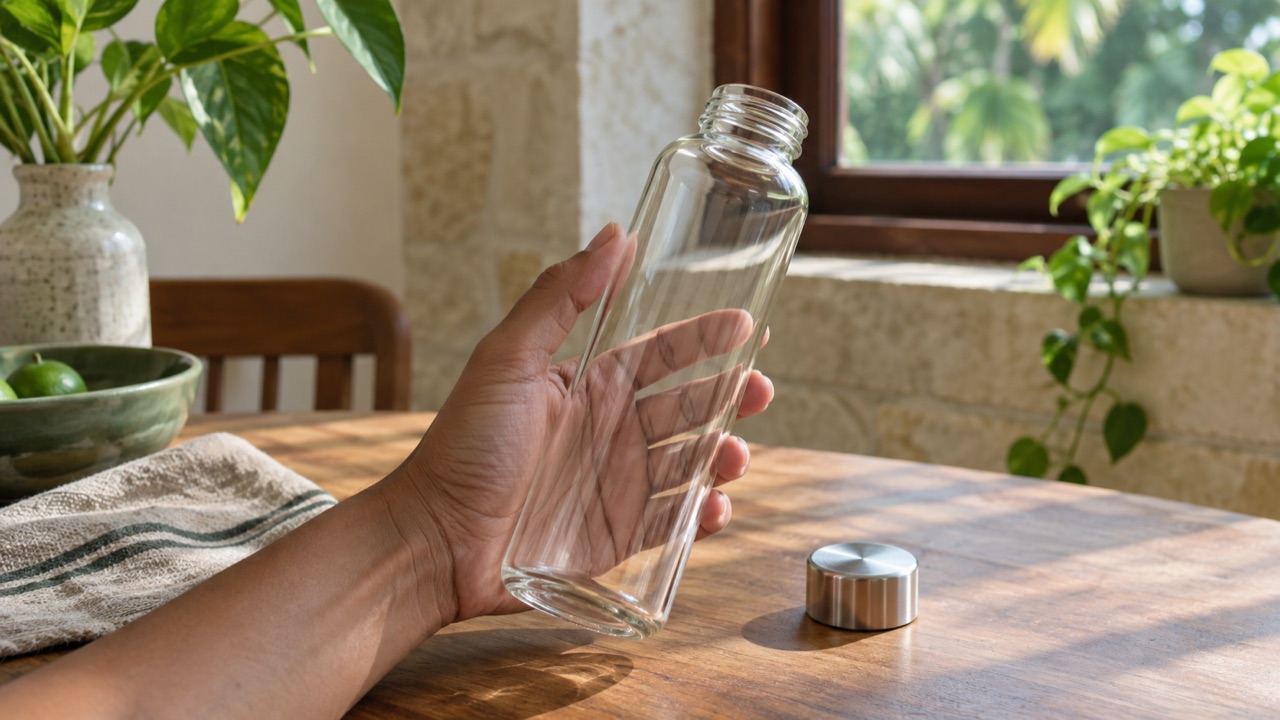
The 30-second quality check තත්ත්වය පරීක්ෂා කිරීම

Glass bottles look alike in photos. In your hand, they don't. Six quick checks — one tap test, five looks — separate the bottle that lasts years from the one that doesn't survive the first month.

The tap test 6 checks මිලදී ගැනීමට පෙර

Check 1

The tap test තට්ටු පරීක්ෂාව

Flick the side of the bottle with a fingernail and listen.

Dull, deep tone = thick wall

Thick glass absorbs the vibration and answers with a low, muted knock. This is what you want for school bags, travel and daily use — it's the difference between surviving a fall onto tile and not.

Bright ping = thin wall

Thin glass rings like a wineglass. Lovely at the dinner table, nervous work in a school bag. If your bottle will travel, keep pinging bottles for home.

Buying online? You can't tap through a screen — so weigh the listing instead: a 500 ml bottle that feels heavy for its size usually means thick walls, and reviews that mention “sturdy” or “thick” confirm it.

Checks 2–6

The rest of the checklist ඉතිරි පරීක්ෂා පහ

2
Weight in handThick glass is heavy, full stop. Two same-size bottles: the heavier one is the better-built one.
3
The capStainless steel caps don't crack or leach like plastic ones — worth the extra Rs. 100. Screw it on and off: the thread should turn smoothly and seat firmly.
4
The sealOpen the cap and look at the gasket. It should sit flat with no gaps. Search reviews for “leak”, or ask the seller's chat directly — leaks are the #1 complaint on drink bottles.
5
Bubbles and seamsTiny scattered bubbles are normal in budget glass — purely cosmetic. Large bubbles at the base, rim or a joint are stress points. Choose a different bottle.
6
The baseIt should sit flat without wobbling, and slightly thicker than the walls. A domed or uneven base tips over on desks.

One more thing

Soda-lime or borosilicate? වීදුරු වර්ග

Soda-lime glass — the everyday one

Almost all budget bottles, including most of the Rs. 349–543 range on Daraz. Perfectly fine for water and juice — but it doesn't like sudden heat. Never pour boiling water into it straight from the kettle.

Borosilicate — the heat-tolerant one

Handles thermal shock far better and usually costs a bit more. Listings that carry it say so explicitly (“borosilicate glass”). If hot drinks matter to you, search for that word.

At the door, on delivery: rim, base, cap thread, leak test, tap test. The full routine is in the Daraz & Kapruka buying guide — with cash on delivery you can reject a bad bottle before paying.

FAQ

Questions we hear ප්‍රශ්න

What is the tap test, again?
Flick the bottle with a fingernail: dull and deep = thick glass, school-safe; bright ping = thin glass, home-only. It's the fastest quality signal there is.
Are small bubbles in the glass a defect?
Tiny scattered bubbles: normal and cosmetic in soda-lime glass. Large bubbles near the base, rim or joints: stress points — pick a different bottle.
Can I pour boiling water into it?
Not into soda-lime glass — the sudden heat can crack it. Only borosilicate handles boiling water comfortably. For sterilizing a soda-lime bottle, warm it gradually instead — see cleaning & care.
How thick is “thick enough” for school?
If it passes the tap test and weighs noticeably more than a juice bottle of the same size, it's school-grade. Add a sleeve and you're covered — the school deals page shows what to look for.

You know a good bottle now — get one at a fair price හොඳ බෝතලයක් තෝරන්න

September 2026 price ranges for every bottle type, in one table.